
Table of Contents
When you study Korean, some words seem similar at first, but feel very different in real situations.
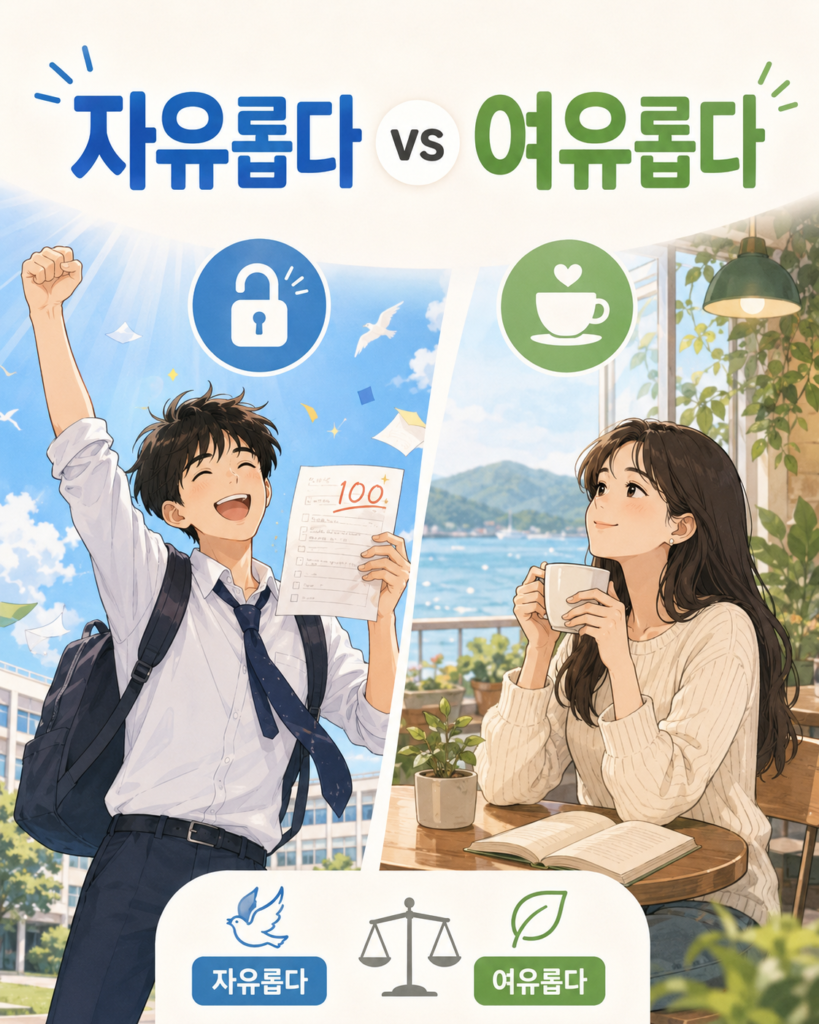
자유롭다 and 여유롭다 are a good example.
Depending on the context, both can be translated into English with words like free, relaxed, or comfortable.
But in Korean, they do not mean the same thing.
Here is the easiest way to start:
- 자유롭다 = to be free from restrictions, obligations, or control
- 여유롭다 = to have enough time, space, or mental room, so you do not feel rushed
So even if both sound positive, the focus is different.
- 자유롭다 is about freedom from something
- 여유롭다 is about having room in your time or mind
Let’s look at the difference with examples.
1) 자유롭다: when something is no longer restricting you
자유롭다 is used when you are no longer being limited by rules, duties, schedules, or pressure.
For example:
- 시험이 끝나서 자유로워요.
= I’m free now because the exam is over.
This does not simply mean “I feel relaxed.”
It means the exam is no longer controlling your time and energy.
Another example:
- 이 회사는 복장이 자유로워요.
= This company is flexible about clothing.
Here, 자유롭다 means there is no strong restriction.
You are not forced to dress in only one way.
Expressions that often go with 자유롭다
- 복장이 자유롭다
- 분위기가 자유롭다
- 선택이 자유롭다
- 표현이 자유롭다
- 행동이 자유롭다
- 일정에서 자유롭다
The key idea is this:
Am I free from a rule, duty, or restriction?
If the answer is yes, 자유롭다 may be the right word.
2) 여유롭다: when you have enough time or mental space
여유롭다 is different.
It does not mean that all restrictions are gone.
Instead, it means you have enough room in your time, schedule, mind, money, or space, so you do not feel rushed or pressured.
For example:
- 오늘은 일정이 여유로워요.
= My schedule is relaxed today. - 주말 아침에는 여유롭게 커피를 마셔요.
= I enjoy coffee leisurely on weekend mornings.
In both examples, the point is not “I am free from obligations.”
The point is “I am not in a rush.”
Expressions that often go with 여유롭다
- 일정이 여유롭다
- 마음의 여유가 있다
- 생활이 여유롭다
- 시간이 여유롭다
- 공간이 여유롭다
- 여유롭게 걷다
- 여유롭게 이야기하다
The key idea is this:
Do I have enough time or mental space?
If yes, 여유롭다 is often the better choice.
3) Example 1: vacation, work, and the difference between freedom and relaxation
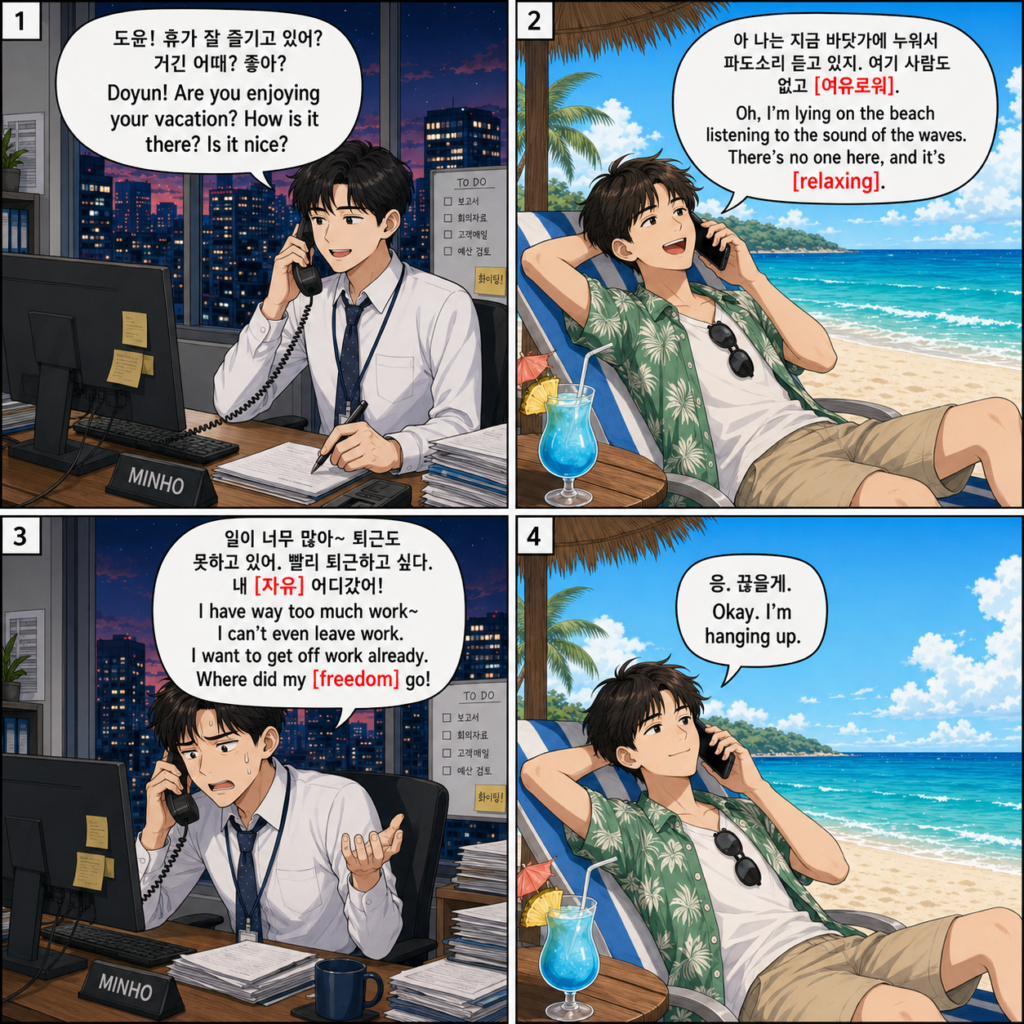
This example shows the difference very clearly.
One person is still at work, surrounded by paperwork, saying:
- 일이 너무 많아~ 퇴근도 못하고 있어. 빨리 퇴근하고 싶다. 내 자유 어디 갔어!
Here, 자유 means freedom from work obligations.
This person feels trapped by work and wants to be released from it.
On the other side, the friend is lying on a beach and says:
- 여기 사람도 없고 여유로워.
This is a great example of 여유롭다.
Why?
Because the focus is not “I am free from rules.”
The focus is:
- the place is calm,
- there is no crowd,
- there is no rush,
- the person feels relaxed.
So in this image:
- 자유 = freedom from duty or pressure
- 여유 = a relaxed, unhurried feeling
This is one of the most important differences between the two words.
4) Example 2: after an exam, both words can appear — but the meaning changes
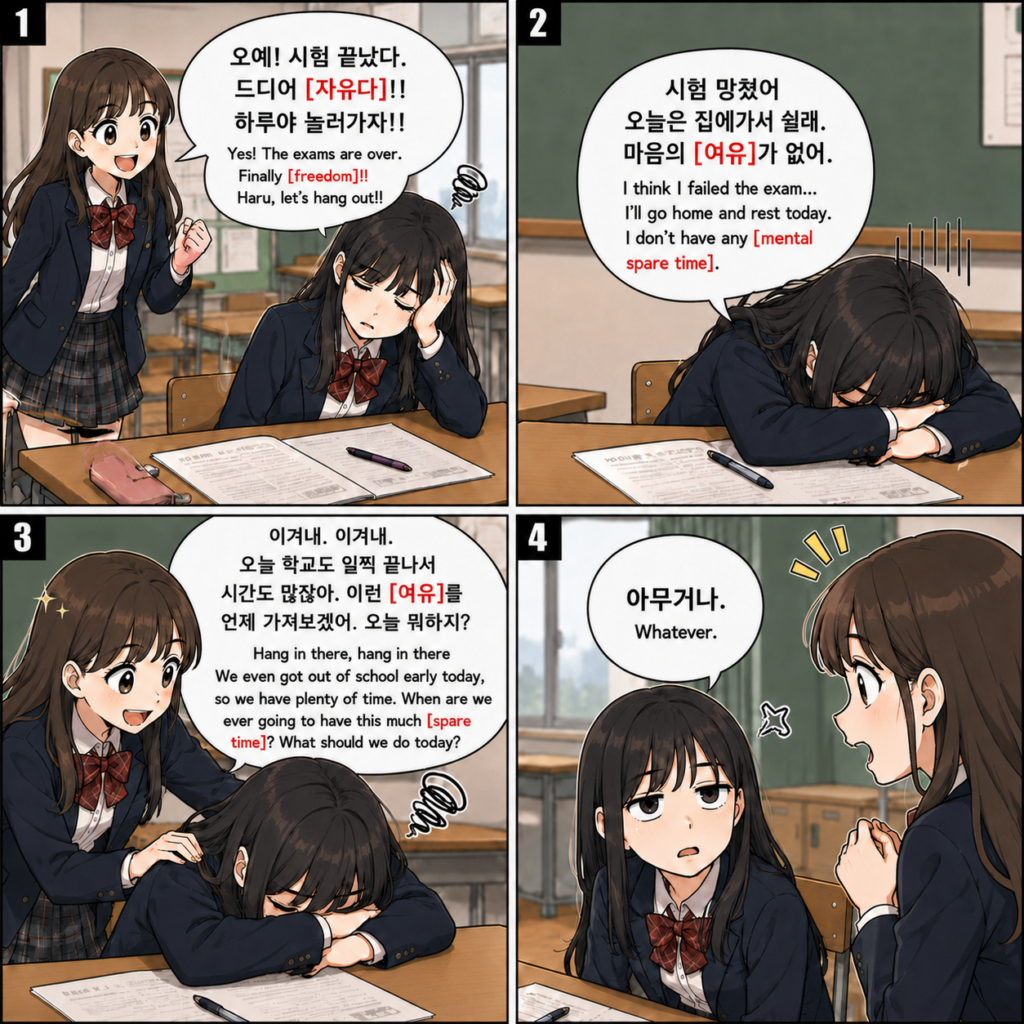
This example is especially helpful because it shows that both 자유 and 여유 can appear in a similar situation.
In the first panel, one student says:
- 오예! 시험 끝났다. 드디어 자유다!!
This means:
“The exam is over. I’m finally free!”
Here, 자유다 is natural because the student is now free from the exam.
But in the next panel, the other student says:
- 시험 망쳤어. 오늘은 집에 가서 쉴래. 마음의 여유가 없어.
This is very different.
The exam is over, so technically that student is also free from the exam.
But emotionally, the student does not feel relaxed.
That is why 마음의 여유가 없다 is used here.
It means:
- “I don’t have the mental space for anything right now.”
- “I’m too stressed to enjoy myself.”
Then later, the friend says:
- 오늘 학교도 일찍 끝나서 시간도 많잖아. 이런 여유를 언제 가져보겠어.
Here, 여유 refers to having extra time and room to breathe.
So this example teaches something important:
You can be free from something, but still not feel relaxed.
That is exactly why 자유롭다 and 여유롭다 are not the same.
5) Can both be used in the same situation?
Yes, sometimes both can be used — but the nuance is different.
For example:
- 시험이 끝나서 자유로워요.
→ I’m free from the exam now. - 시험이 끝나서 여유로워요.
→ Now I feel more relaxed and unhurried.
These two sentences are related, but they do not say exactly the same thing.
Compare the focus
자유롭다
- I am no longer tied down.
- I am released from something.
여유롭다
- I have enough room now.
- I do not feel rushed or emotionally tight.
So when both are possible, ask yourself:
Am I talking about being released from something?
Or am I talking about having enough room in time or mind?
That will help you choose the right word.
6) Common mistakes learners make
Because both words can sound similar in English, learners often mix them up.
1. 오늘 시간이 자유로워요 ❌
This is understandable, but not natural in most situations.
If you want to say you have enough time, say:
- 오늘 시간이 여유로워요.
- 오늘 시간에 여유가 있어요.
Why?
Because time is about room or availability, not freedom from restriction.
2. 여기서는 여유롭게 이야기하세요 △ / sometimes unnatural
If you mean:
- “Please speak freely.”
- “You can say whatever you want.”
then use:
- 여기서는 자유롭게 이야기하세요.
Because the point is freedom of expression.
But if you mean:
- “No need to rush. Take your time.”
then 여유롭게 works better.
So again, the difference depends on the focus:
- 자유롭게 = without restriction
- 여유롭게 = without rushing
3. 마음이 자유롭지 않아요 / 마음의 여유가 없어요
These can both be possible, but they are different.
- 마음이 자유롭지 않아요
= My mind doesn’t feel free.
(Something is weighing on me or binding me emotionally.) - 마음의 여유가 없어요
= I don’t have the mental space.
(I’m stressed, tired, or overwhelmed.)
In daily conversation, 마음의 여유가 없다 is much more common when talking about stress or emotional pressure.
7) A simple way to remember the difference
If you are not sure which one to use, try this.
Ask yourself:
자유롭다
What am I free from?
Examples:
- exams
- work
- rules
- pressure
- restrictions
여유롭다
What do I have enough of?
Examples:
- time
- space
- money
- emotional room
- calmness
This is a very practical way to choose the right word.
8) Final summary
Let’s keep it simple.
자유롭다
= free from restrictions, obligations, or control
여유롭다
= relaxed, unhurried, or having enough time and mental space
So:
- If something is no longer tying you down, use 자유롭다
- If you are not rushed and have room in your schedule or mind, use 여유롭다
A person on vacation may feel 자유롭다 because they are away from work.
A person lying quietly on the beach may feel 여유롭다 because everything feels calm and unhurried.
And after an exam, you may be 자유로워도, still not have 마음의 여유.
That is the difference.
One-line takeaway
자유롭다 = no restriction
여유롭다 = no rush